
Building Demolition Dubai | High-Rise & Commercial | Al Mrooj
The Problem: Building Demolition Is Engineering, Not Just Force
Commercial and high-rise building demolition in Dubai operates under a completely different regulatory framework than residential projects. Any structure exceeding four stories or containing basement levels requires a Civil Defence demolition permit in addition to the standard Dubai Municipality approval. The method statement must be signed by a structural engineer registered with both DM and the Society of Engineers — UAE, and it must include a load path collapse analysis. Buildings in dense districts such as Downtown Dubai, Business Bay, and Al Quoz Industrial Area sit within meters of Metro lines, active roadways, and fully occupied towers. A single uncontrolled debris fall or crane collapse does not just delay a project — it shuts down Sheikh Zayed Road traffic, triggers a federal safety investigation, and exposes the developer to criminal liability. Noise restrictions in commercial zones often mandate night-shift demolition or decibel limits below 55 dB at the property boundary. For smaller residential structures, see our villa demolition services.
Our Building Demolition Process
Al Mrooj follows a five-phase engineered process for commercial and high-rise demolition. Each phase is designed to maintain structural stability until the exact moment of controlled removal.
01 — Structural Assessment & Load Path Analysis
Before any equipment is mobilized, a DM-registered structural engineer conducts a full frame analysis. The engineer maps the primary load paths — columns, shear walls, and transfer slabs — and designs either a controlled collapse sequence or a top-down sequential deconstruction plan. This plan is submitted to Dubai Municipality and Civil Defence for joint approval. For buildings within 15 meters of adjacent structures, the plan includes finite element modeling to predict vibration transmission and settlement impact.
02 — Hazardous Material & Utility Isolation
Commercial buildings over 20 years old frequently contain asbestos insulation, PCB-laden electrical transformers, and fuel residues from generator tanks. A licensed hazardous material contractor removes these under sealed containment before structural work begins. All utilities — DEWA power and water, Etisalat/Du fiber, district cooling lines, and gas connections — are formally disconnected and physically capped at the property boundary. A ruptured 300mm district cooling line can flood a basement with 50,000 liters of chilled water and halt the project for two weeks.
03 — Interior Soft Strip
All non-structural elements are removed before breaker work starts. This includes drywall partitions, suspended ceilings, MEP ductwork, electrical cabling, aluminum glazing, and raised access floors. Soft stripping reduces the final structural mass by up to 40% and allows segregated recovery of high-value recyclables — copper wiring, aluminum framing, and salvageable mechanical equipment — before they are contaminated by concrete dust.
04 — Structural Deconstruction
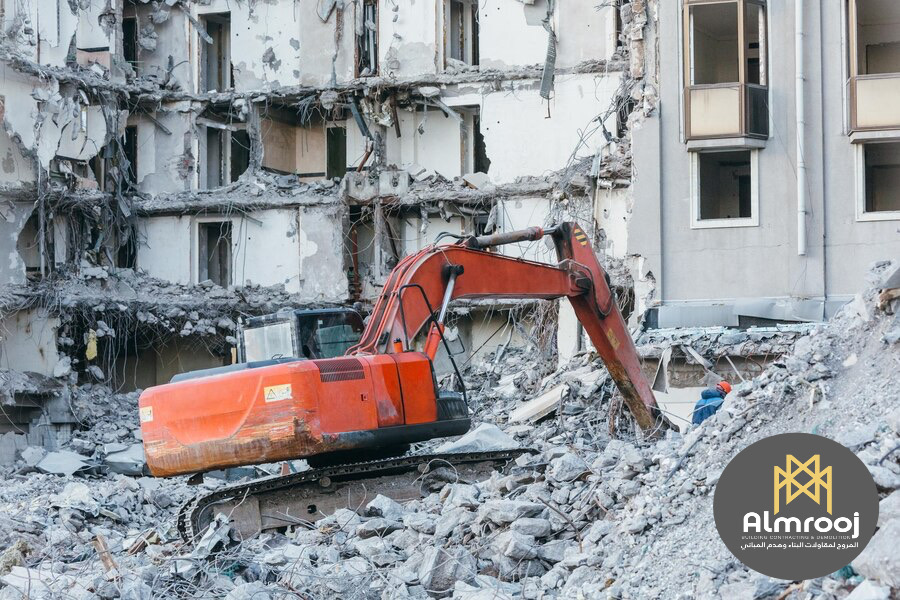
For buildings up to 12 stories, we deploy high-reach excavators with 40-meter boom extensions and hydraulic pulverizer attachments. The machine works from the roof downward, removing one floor at a time while temporary steel bracing maintains lateral stability. For confined sites where swing radius is restricted, we use remote-controlled robotic demolition machines for interior column removal. Precision concrete removal during this phase often requires concrete cutting services to separate transfer slabs and boundary walls before the main frame comes down.
05 — Waste Processing & Site Handover
Concrete is crushed on-site using mobile jaw crushers to produce GSB material for road base and backfill. Steel rebar is cut into 1.5-meter lengths and transported to Jebel Ali smelters. The site is graded to the specified level, and a DM completion certificate is issued after final inspection.
Equipment & Capability
High-Reach Demolition Fleet
Building demolition demands industrial-scale equipment that villa projects never require. Al Mrooj maintains a fleet of high-reach excavators from Hitachi and Caterpillar with boom extensions up to 40 meters, capable of reaching the twelfth floor without supplementary tower cranes. For reinforced concrete frame buildings, we use tower crane-mounted wrecking balls where high-reach machines cannot achieve sufficient reach or where the foundation cannot support the excavator’s ground pressure.
Remote & Precision Equipment
Interior work in structurally unstable or confined spaces is handled by Brokk and Husqvarna remote-controlled robotic demolition units, which eliminate operator exposure to falling debris. Our hydraulic concrete pulverizers and metal shears separate rebar from concrete in real time, allowing direct loading into segregated haul trucks. Dust suppression on high-rise projects is managed by high-pressure mist cannons with 50-meter throw ranges, not standard water sprinklers.
Material Processing & Environmental Control
For precise openings in remaining structural walls, we deploy concrete core cutting with diamond core drills up to 600mm diameter.
Compliance & Safety
Every commercial building demolition project complies with Dubai Municipality Demolition Code DM-2023-SEC-04, UAE Fire and Life Safety Code, and Civil Defence circulars for high-risk demolition. Civil Defence approval is mandatory for all structures exceeding four stories or with basement parking levels. If the site borders a main road, an RTA-approved traffic management plan is implemented with lane closures, detour signage, and flagmen. For noise-sensitive zones, we secure night-work permits and operate within strict decibel limits. Adjacent buildings are monitored daily using tilt sensors and crack-width gauges to detect any settlement or vibration transfer. High-rise projects require perimeter scaffolding with debris netting and catch platforms to protect pedestrians and vehicles below.
Proof: Al Quoz Industrial Area 3 Commercial Warehouse
In early 2026, Al Mrooj completed the demolition of a six-story commercial warehouse in Al Quoz Industrial Area 3. The 12,000 square meter reinforced concrete frame was located just 8 meters from an active manufacturing facility that had to remain fully operational throughout the project. Due to the proximity constraint, we used Brokk robotic demolition machines for the interior soft strip and column reduction, achieving zero vibration transfer to the neighboring facility. The structural frame was then deconstructed using a 40-meter high-reach excavator with a hydraulic pulverizer attachment. The project was completed in 18 working days. Eighty-two percent of materials were recycled — concrete crushed on-site for sub-base aggregate, and steel rebar sent to Jebel Ali smelters. The project received Civil Defence and Dubai Municipality clearance without a single safety incident or adjacent property damage claim.
Get a Free Building Demolition Assessment
Email: info@almrooj.ae
Discuss Your Building Demolition Project
Speak with the Al Mrooj team about site requirements, safety planning and the next practical step.